Mythologies For The Future
21/09/2025
A visit to Paula Turmina's studio
Mythologies For The Future
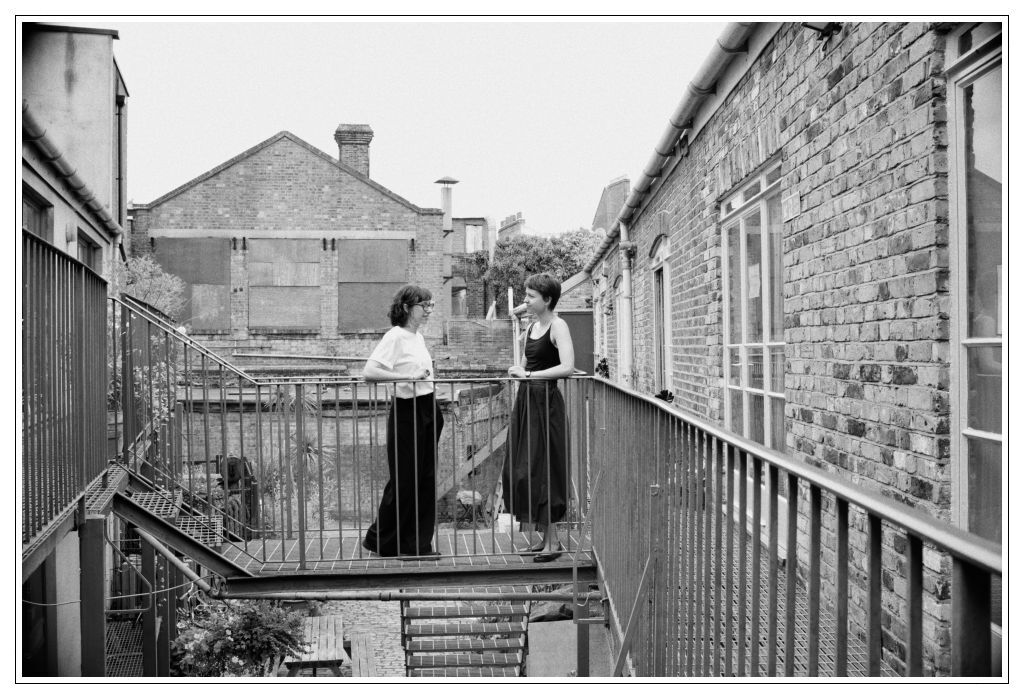
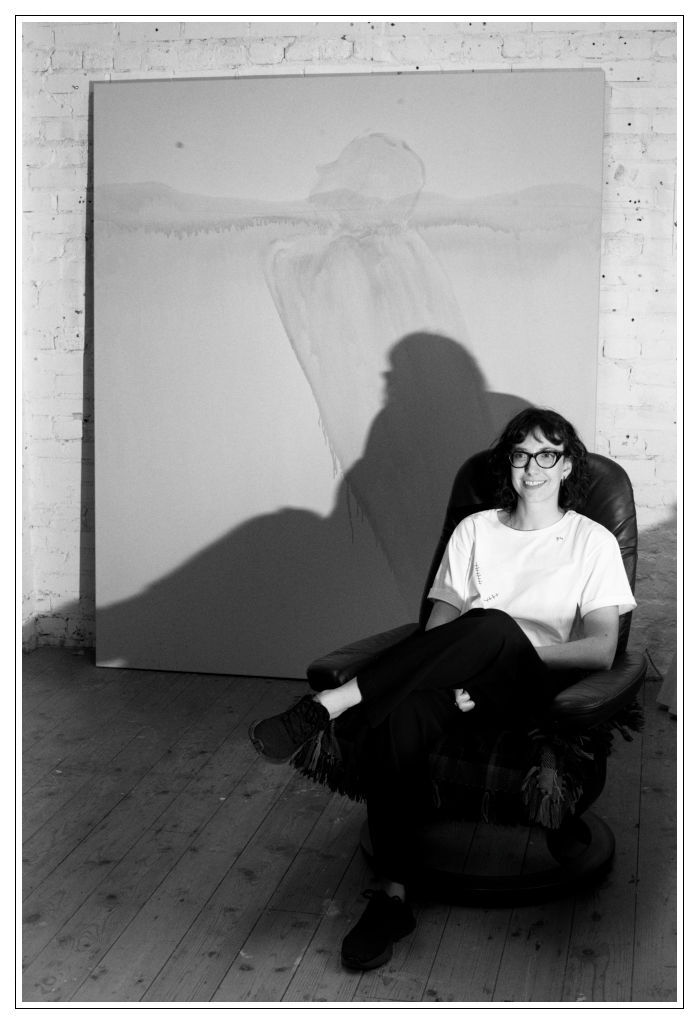
Paula greeted us at a heavy metal gate at the end of a cobblestone cul-de-sac. A warm smile, elegant, slight and smart in a white T and black trousers, she let us into a quiet oasis; a courtyard lined with hanging baskets and plants, on both sides lined by tall windows to artists’ studios. On the first floor; right at the end of a metal walkway, suspended seemingly mid-air, was her studio. I felt I was walking on water, how intangible the wire mesh seemed. Subconsciously I always prolonged my step to reach the next frame supporting it. Unnecessarily though; the structure, as ephemeral as it might have appeared, was of a solid nature.
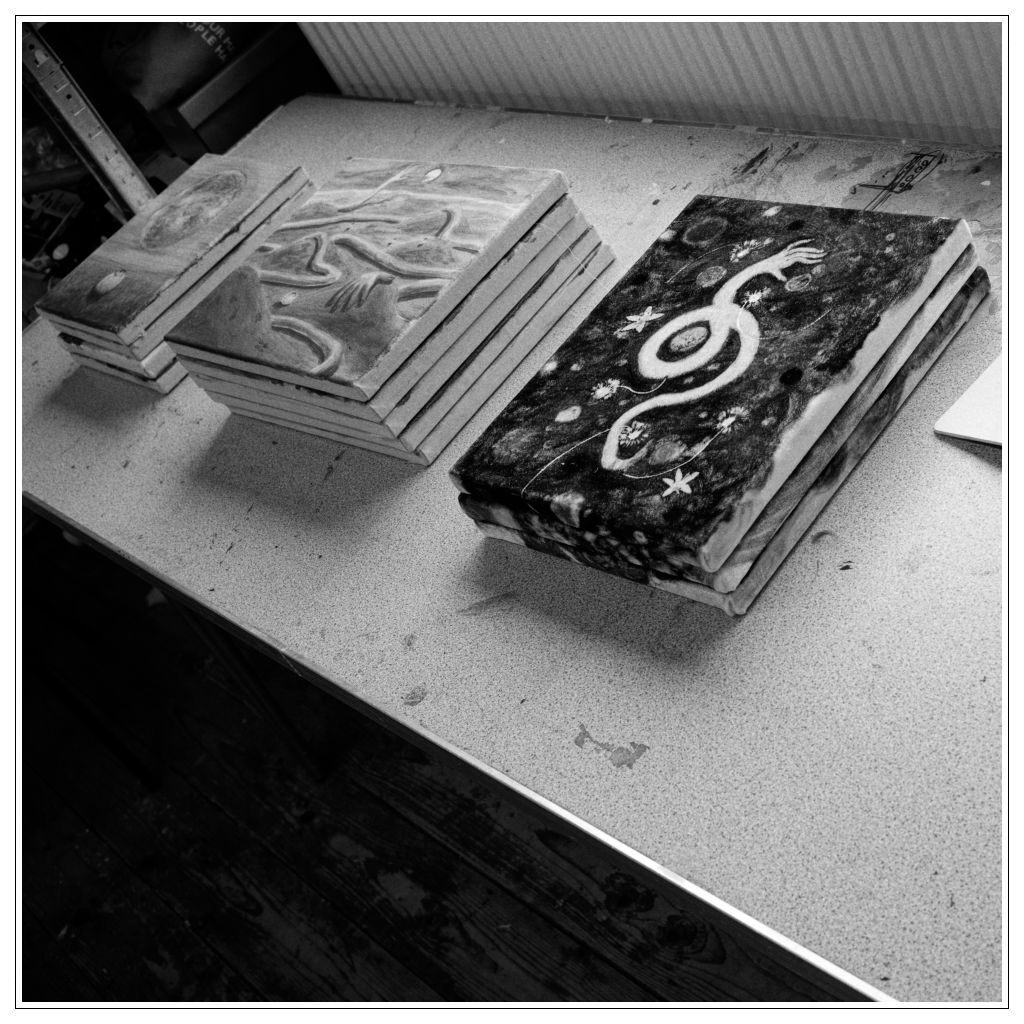
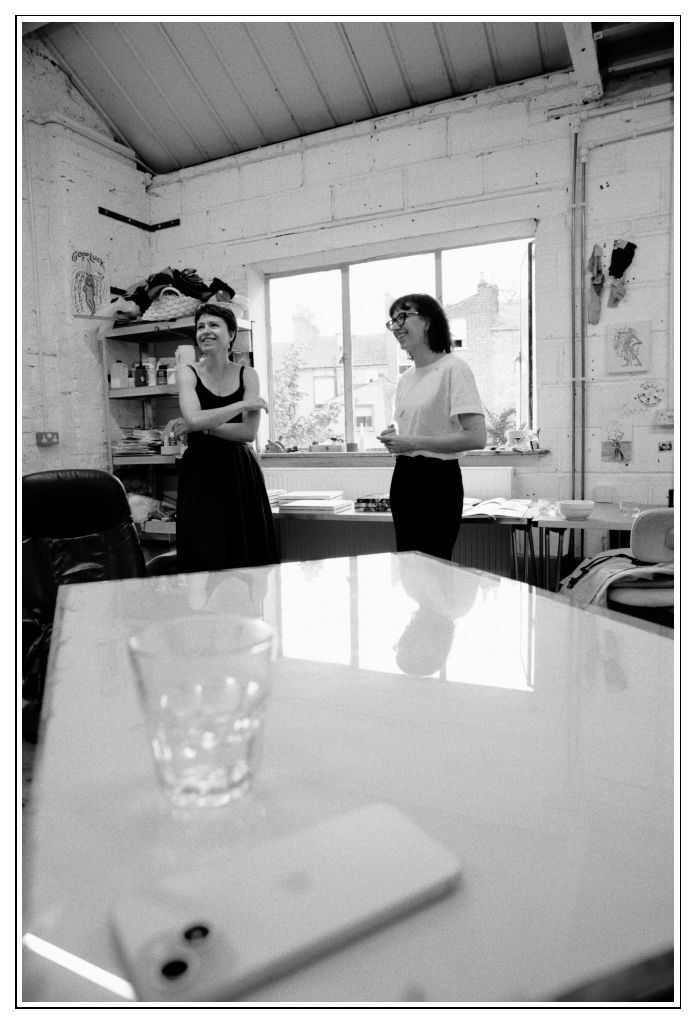
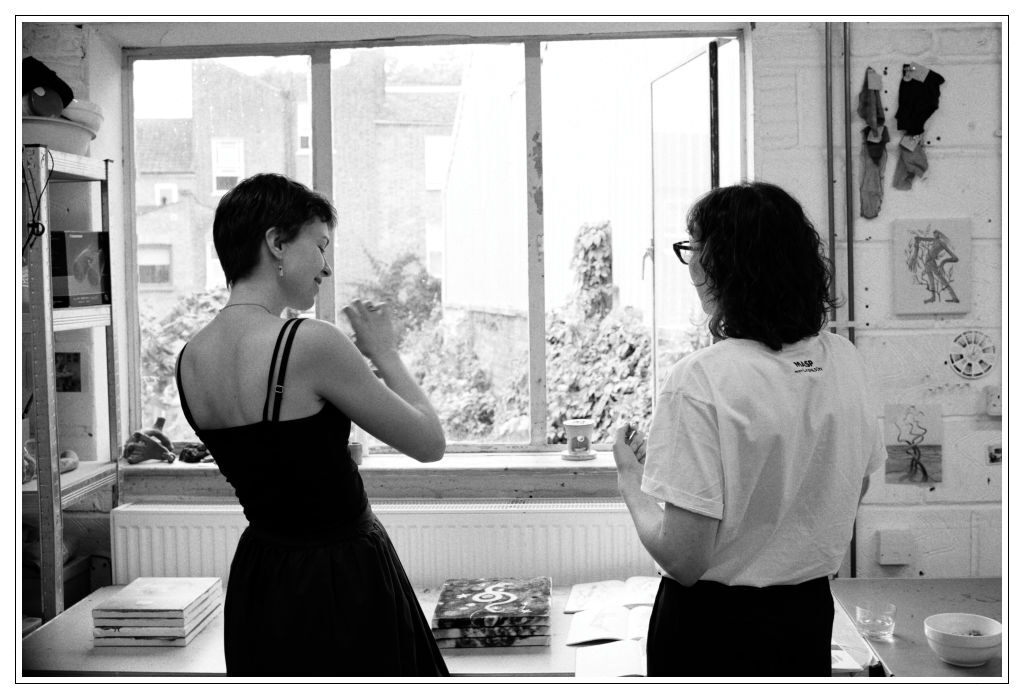
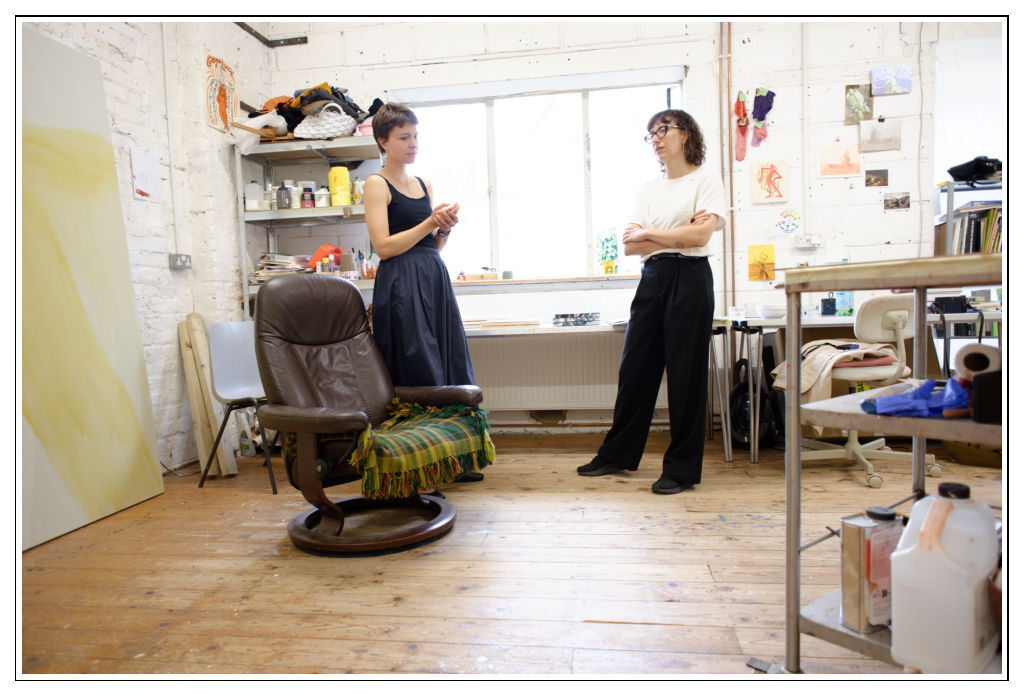
Paula’s studio has a quiet and contemplative atmosphere. “Just as an aside, you win the award for the cleanest palette” says Jon. Without skipping a beat and with a sound of unshakeable confidence Paula replies “Yes, I know. “ We all laugh as Paula adds “ You can even leave your camera there.” And it’s true - that’s where I leave my phone and where Jon keeps his spare camera during our visit.
The room’s subtle and subdued atmosphere is rhythmically lit up by an orange-red glow, emanating from Paula’s canvases. A studio as a temple to painting, the subtle atmosphere not that far from one you might experience in a cathedral with the sun shining through stained glass windows the colour of red embers. Paula’s paintings are windows to an inner world; a womb-like space; and at the same time portals to another world that feels alien and unknown; another planet.
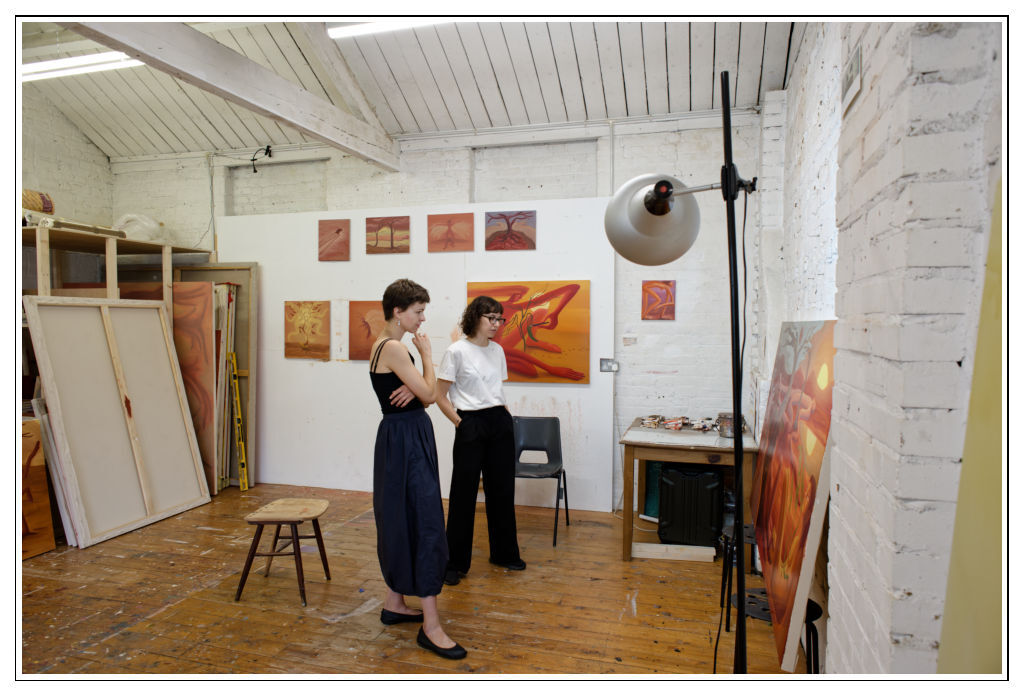
We began talking about the dominant colour; red; and its significance in Brazil’s history; Paula’s country of origin. The story of Brazil is intertwined with the colour of red. Connected to blood with its hue; and in the fact that the sap of the once common Brazil tree can be turned into a potent red dye. In the absence of other valuable resources the Portuguese settlers turned their focus to mining this tree; now present only in protected natural reserves. It is the same orange-red hue that is a predominant colour in Paula’s paintings.
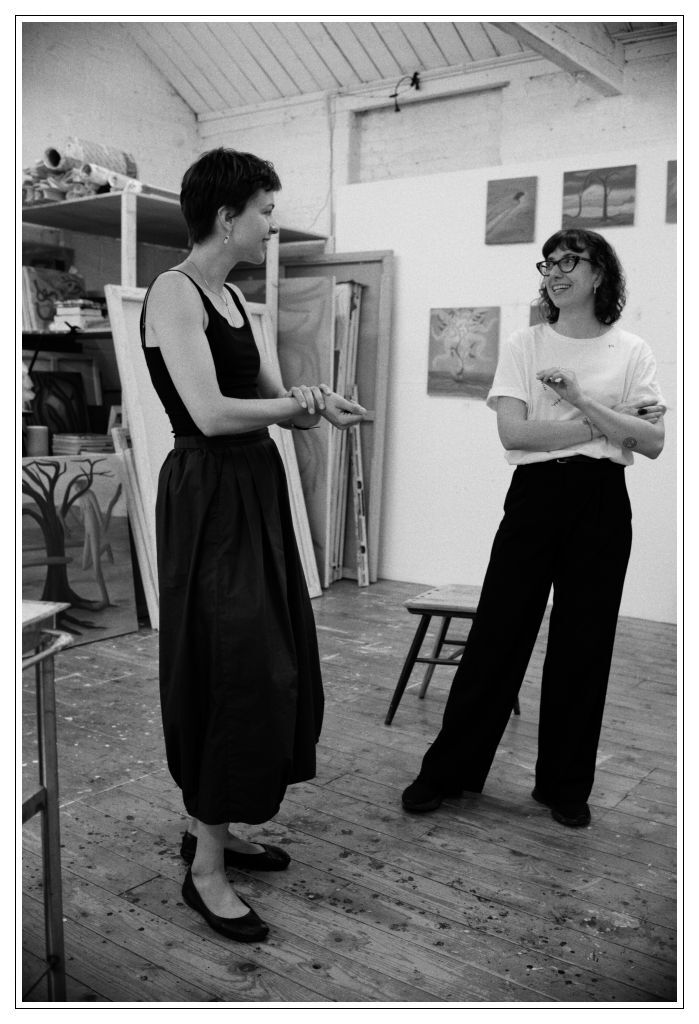
“In my work I want to bring and offer something more … a world where these characters sort of find their ways to inhabit this space that might have been exploited. But right now they are finding new ways of integrating and interacting with it.”
A parallel is drawn to question human’s surviving attitude towards resources and environment in general. Yet here is hope; as there was back then; a symbol of resistance; like the native ants that devoured the first conquistadors’ crop of imported food nearly overnight. Those ants make a return in Paula’s paintings too.
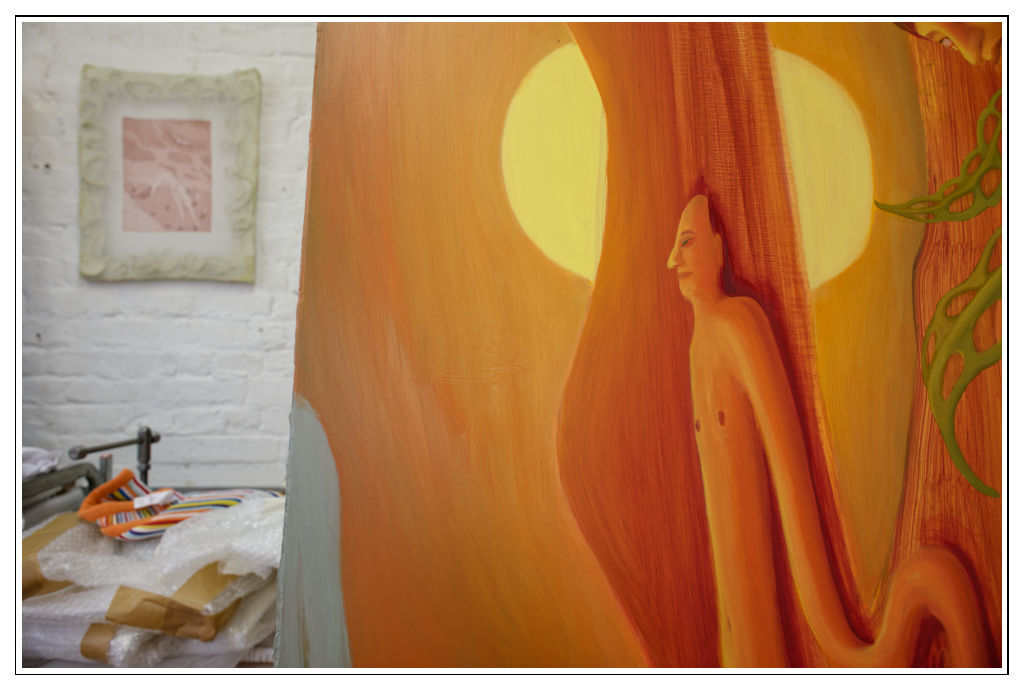
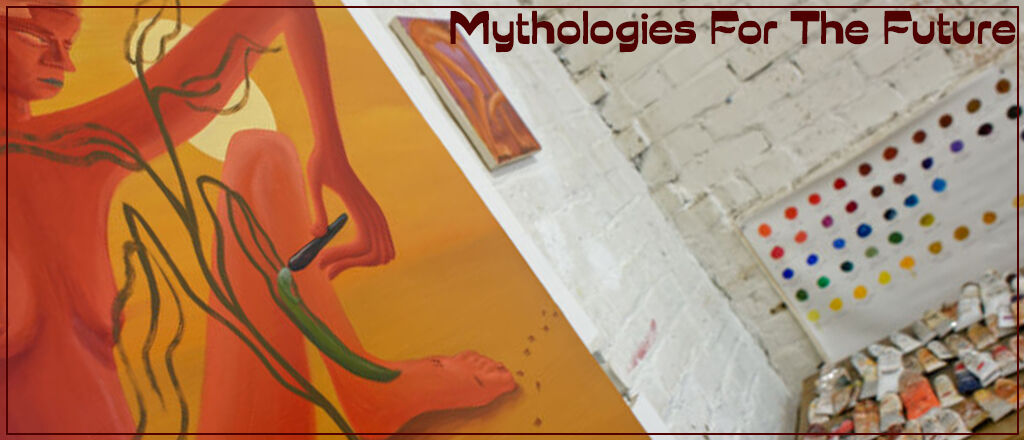
To our left is a rectangular canvas, seated in its centre is a female figure; or, female-like; distorted, prolonged, red, elfin; alien and deeply familiar at the same time. Not an anatomically rendered figure; an allegory to life, but in abandoning some of the visual similarities, more alive than a realistically drawn figure could be. She sits on a plain without a horizon, and within her arms, almost in her embrace, she paints bright green strokes. In the process of her painting the paint and the brush itself becomes alive and morphs into the leaves and stems of a sprouting plant.
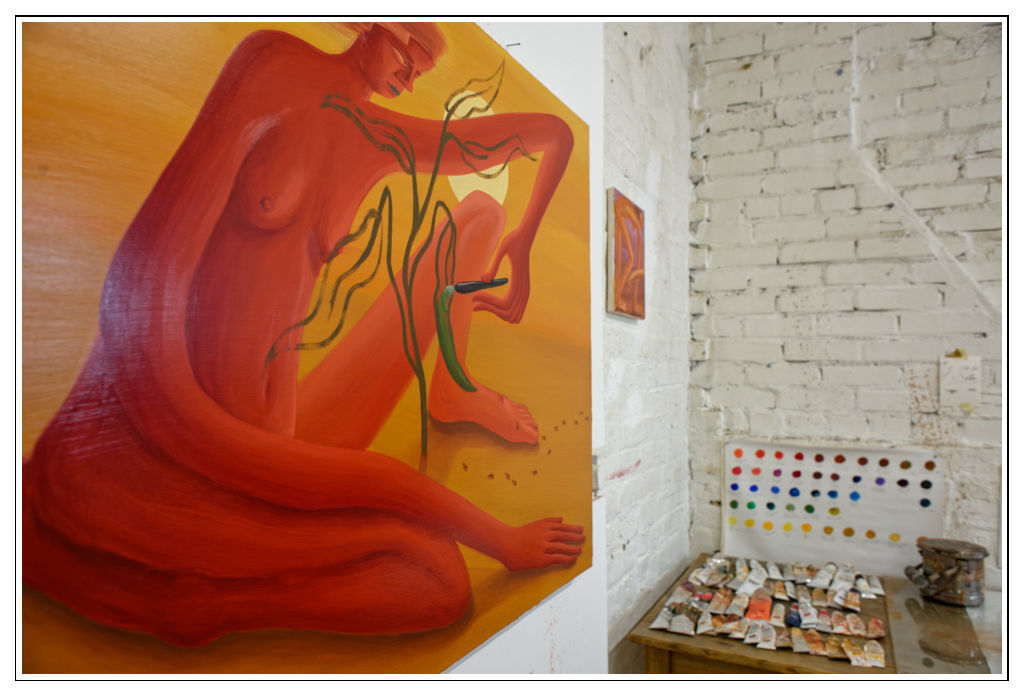
Paula says, well but it is not alive as it is ‘just’ paint… To which I point out, look, it still is a thing of creation, alive; you’ve painted the ants coming towards it, and so they must be able to smell it, sense it. It is alive.
“I was also reflecting on the act of painting.”
“Oh I didnt realise she is actually painting the plant!”
We laugh
“I was thinking about subjects that are difficult and painting is not doing anything more than what it does, everyone will have their own reaction to it. I felt like this character was trying to recreate the plant, but it’s ‘just’ a painting after all. It’s a painting, it’s something that they are creating and [therefore] not alive.
“But then it must be because the ants are going up to it.”
“Well there you go! ” says Paula and we both laugh.
To the far end, nearer the window, leaning against the wall, is the biggest canvas present in the studio, in its first stages, as Paula says, allowing it breathing room, until it calls for, asks for or needs more. A figure; made out of a few large, fluid wash-like brushstrokes is emerging out of a veil of colour; from a body of water. It has no arms, yet the shoulders seem to hide the elbows of angel’s wings folded / just about to shoot upwards, from the depth of the ocean towards the skies.
But the angel is light yellow; pale and vivid at the same time; not a colour of the sun; nor of distance. The sky, the whole picture is otherwise the palest blue-green, to a point it would read as neutral or white. Those two colours oscillate; pulling and crossing the lines between above and below, just as the figure that is about to emerge from the water.
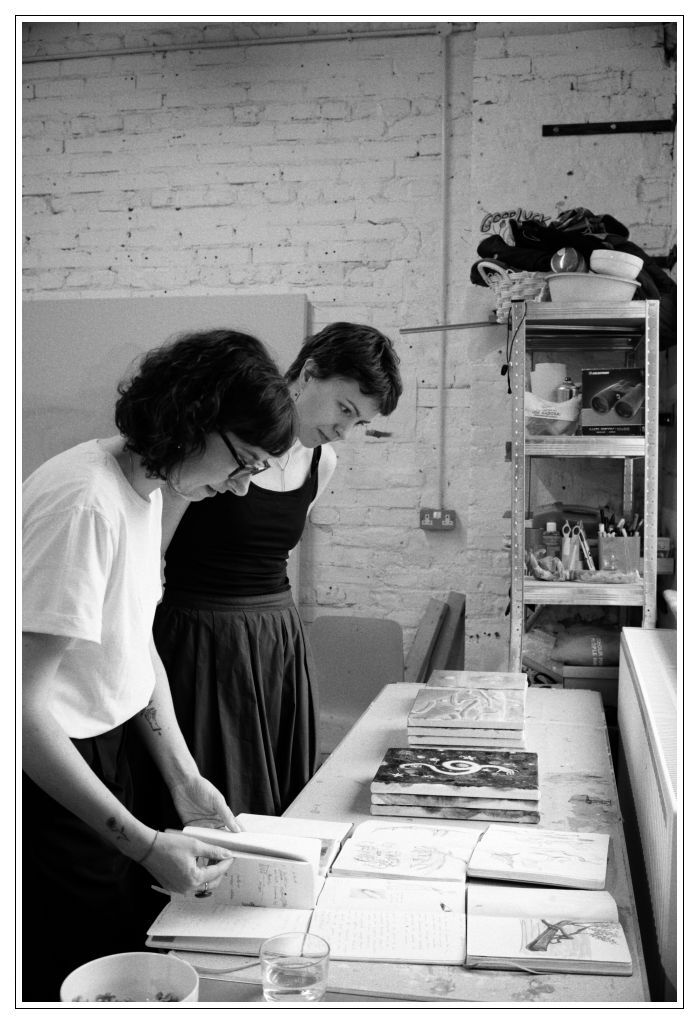
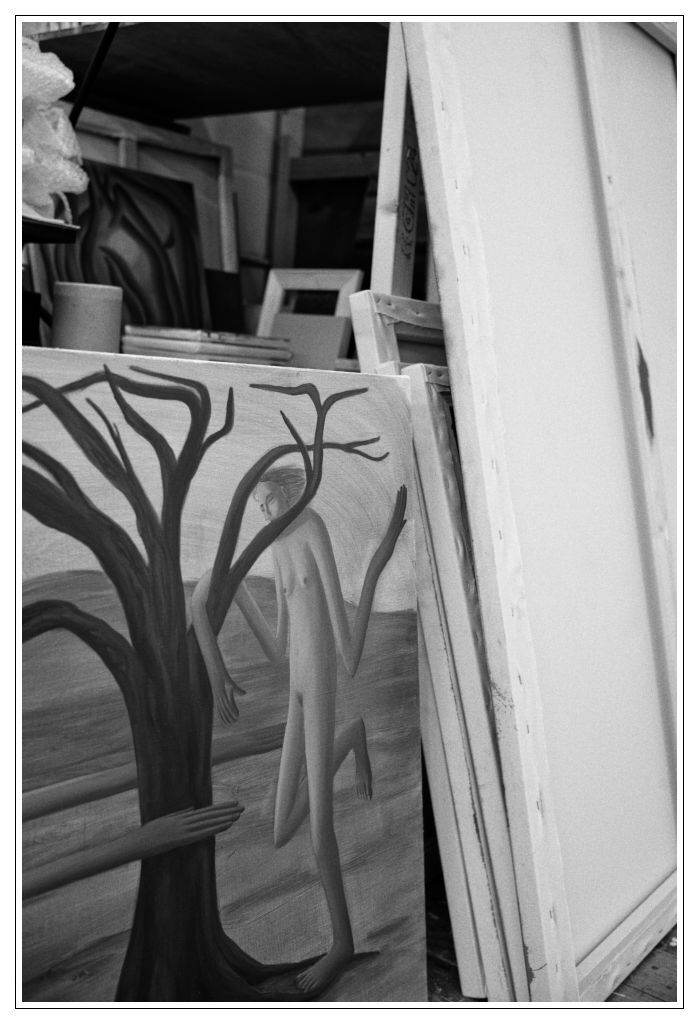
We look through Paula’s sketchbooks, where pages of line drawings depicting scenes from this other, yet already well-established world emerge and are interspersed with pages of handwritten text.
We spoke of Andrei Tarkovsky, and the surreal and metaphysical moments of stillness in his films.
And similar to Tarkovsky’s more surreal scenes, Paula’s paintings are not only moments of stillness but also a distillation of a particular mood. And sometimes that distillation traverses to the absurd, obscure and extra-ordinary, bizarre, for it is not one of a stream of images or scenes, but a process, a journey taken in time; and its nature encapsulated into one two dimensional image.
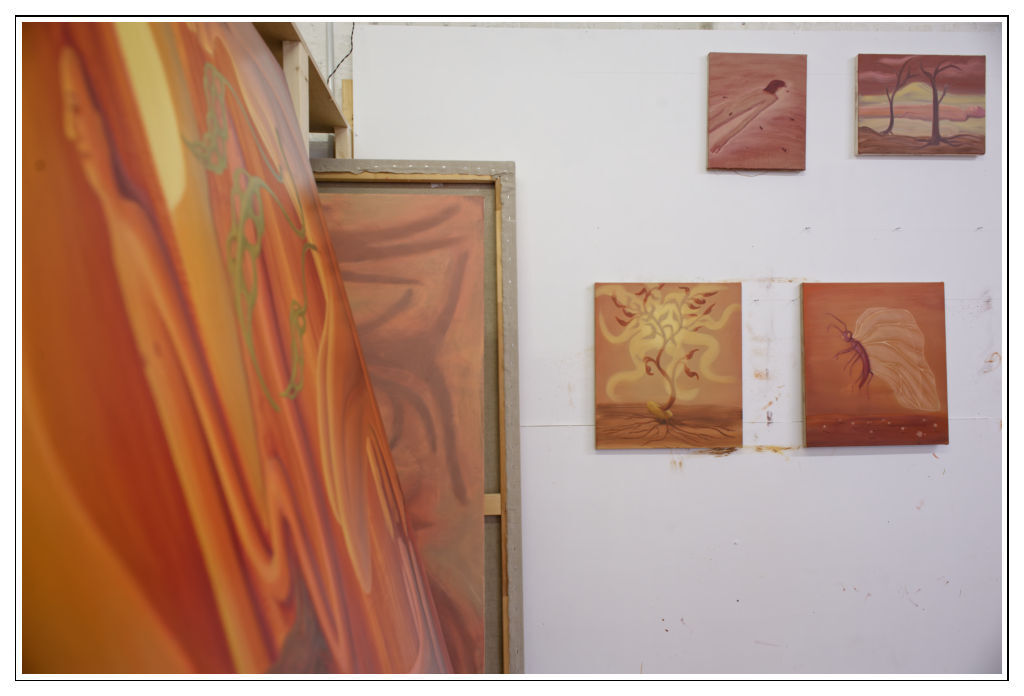
Paula’s paintings are figurative and abstract at the same time. The human-like figures are equally human and equally abstract figures of metaphor. Where is the line between poetry and painting? Can certain things be said in one way, and not quite the same in another? I notice a smaller canvas, hung up high. In the centre is a person, lying on their front, half buried in the vermilion orange sand that seems to stretch ad infinitus. Not devoid of purpose, but not an active participant either. In limbo. Towards him, as this one seems to be more male than female, is a row of ants advancing. Not ominous or threatening, perhaps curious, perhaps mysteriously able to heal this state of in between; we don’t know.
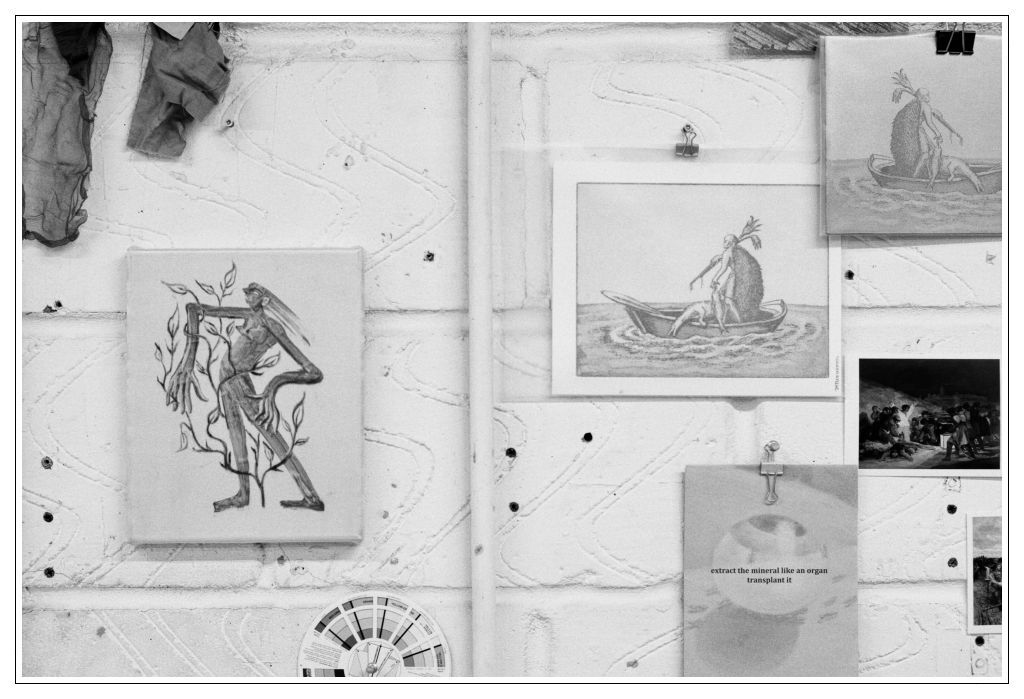
The way these symbols communicate is unique to the medium of paint; pointing to another world and yet so deeply of this one. A painted image has the potential to communicate to something deep within us; a mode of imagination that goes beyond words, and Paula’s paintings possess this ability to transport us; we go on a journey to another world, whose rules we need to intuit, and when we come back to our own reality we can understand and be of something more.
You have to fall in love with that colour, and in that they are singular and uni-amorous. Re-listening to our interview, I walked through a patch of fully grown trees and while walking on the path it felt like being in a forest, but really they were just a narrow strip of conifers stretched between a tall blue-green-cobalt stalks of corn on the left, and barely visible houses on the other side.
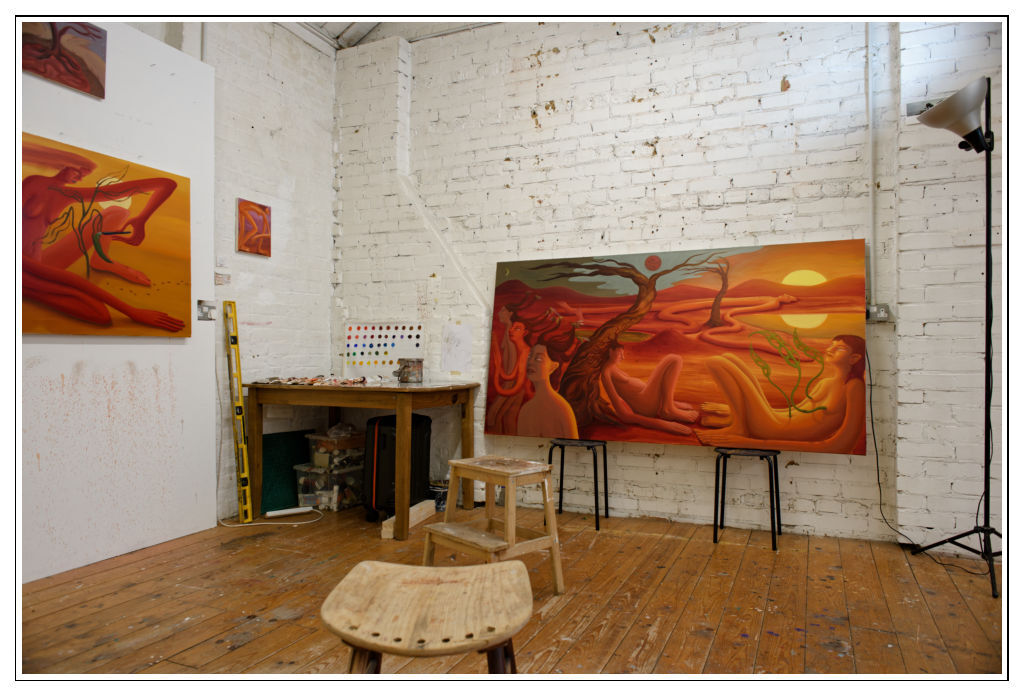
I was reminiscing about the world that exists in Paula’s paintings, and realised I was walking in a world that was completely reverse to that ember-red glowing environment. The red world was leafless, free of what we associate with the cycle of life on our Earth as we know it, and as such it might look or feel depressing. But it doesn’t, because through using symbols that we can relate to, but in a way that creates a language of her own, the stories in Paula’s paintings and drawings suggest that the red land is not life-less; the landscapes and figures, two expressions of the same entity, are imbued with this other life.
Hope is presented as a paradox – a plant growing out of the stomach of a trance-caught figure, her mind in a state of forgetful existence yet still purposeful. Another figure within the same image has a growing, round stomach; “[S]he is pregnant and sort of connected to the tree so there is a question of how she got pregnant. This one is sprouting so something [is] coming out of the body, and that one is sort of melting and surrendering to the landscape..” adds Paula as we look at the painting and uncover its many layers. Here nature and human bodies form an indivisible part of the same cycle; fertility of one is broken without the other. There is a fine line between being nihilistic while entertaining the bizarre, but the narrative we are shown and read balances on that knife edge - and what it communicates is hope. The hope that by abandoning our structures that separate ourselves from the world around us, we may find a way to save it; and us too.
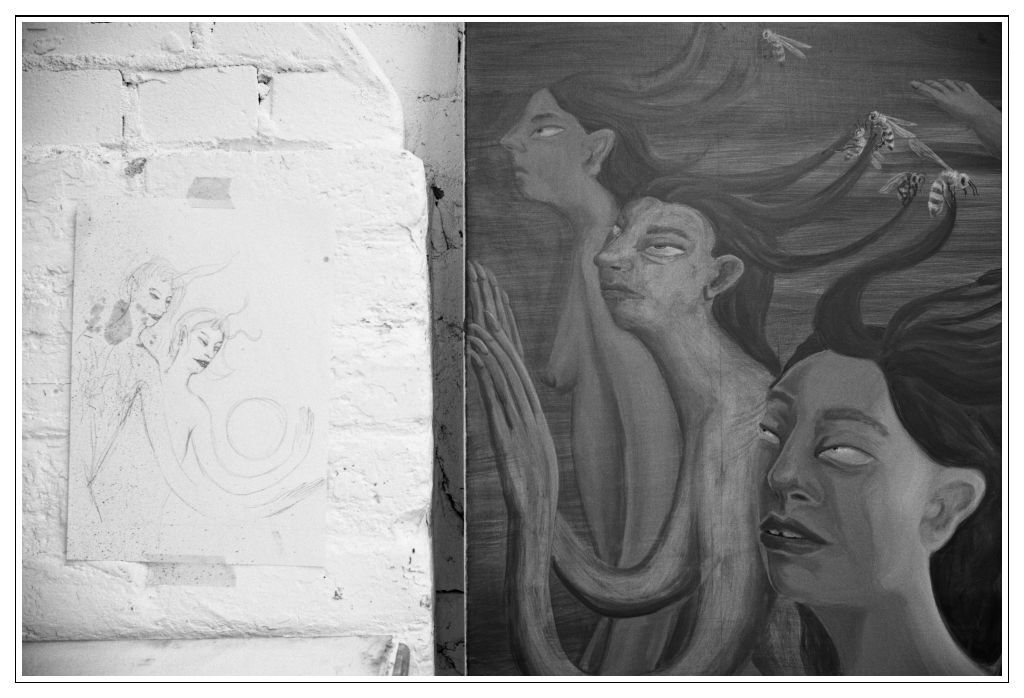
Without what would appear as a functioning environment, we are perhaps more drawn to what is left - or rather the few signs of what is yet to emerge. Coming to Paula’s studio, I have been thinking about mythology, about the stories and narratives that lie at the root of our consciousness and imagination, archetypes that go beyond culture; time and space. Stories that were shaped by the forces of the world around us and within us, and that we told in order to help us understand them.
It was a question that wasn’t asked, yet our conversation seemed to direct to the answer; perhaps rather than looking for meaning in the mythologies of the past, Paula Turmina is creating a mythology for the future.
Text © Martina Šišková
Photographs © Jon C Archdeacon