Systems In Demand
15/04/2026
A Conversation Piece with Emma Cousin
Emma Cousin
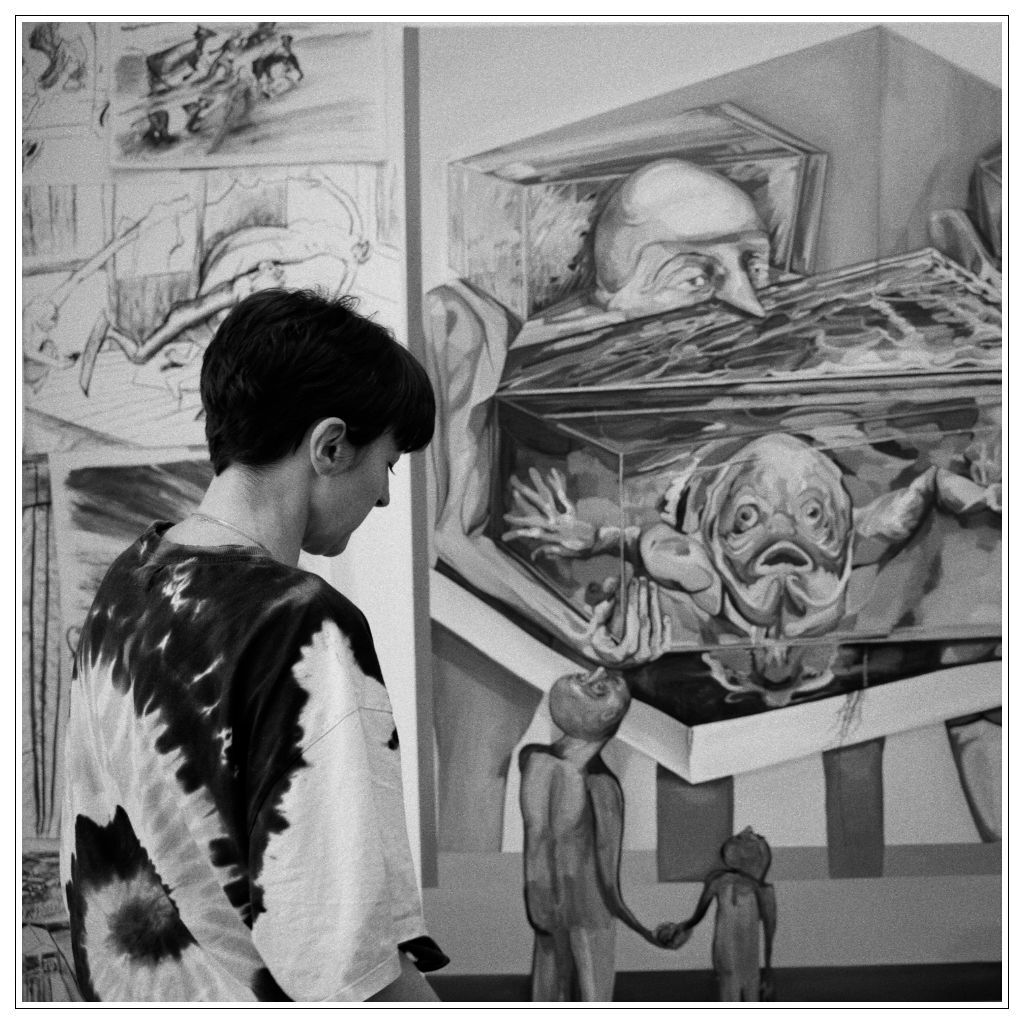
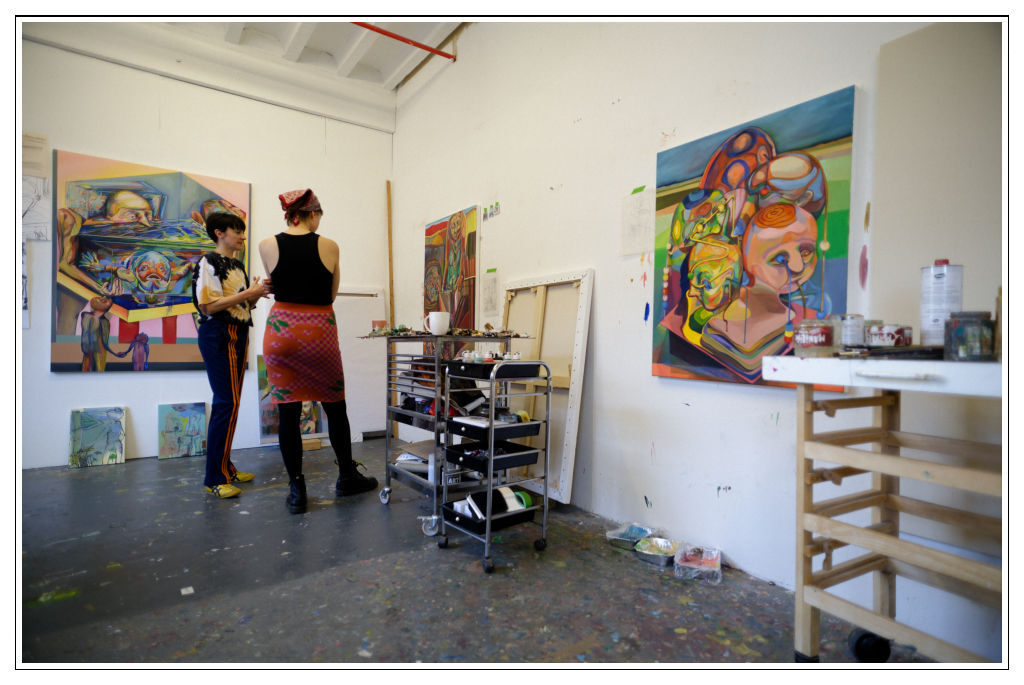
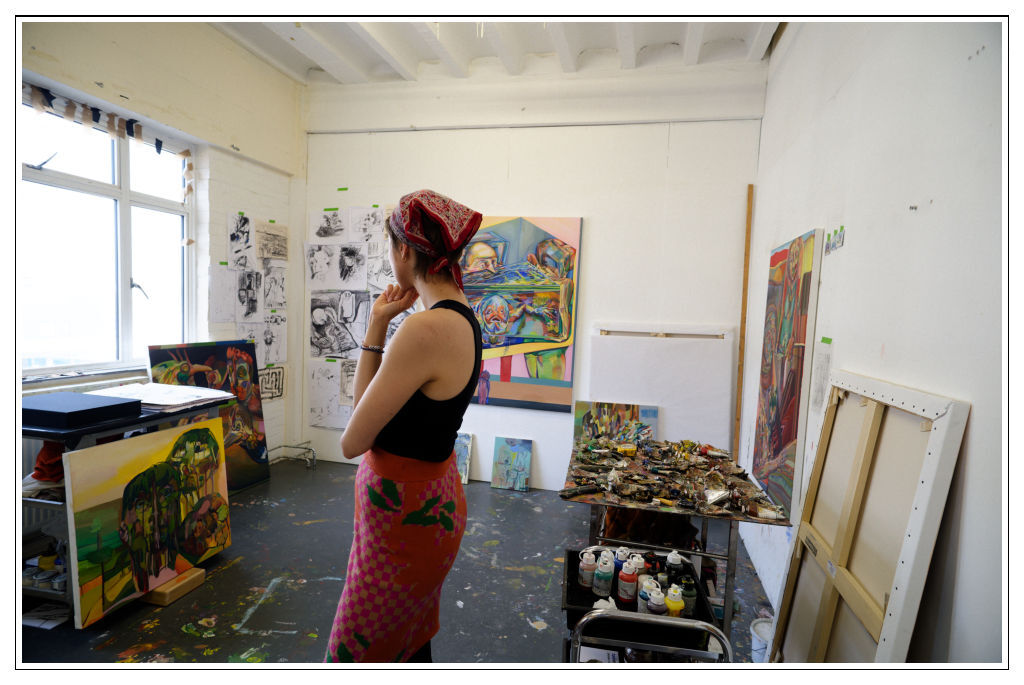
Emma welcomed us in her studio near Old Kent Road; lively; slender built and bursting with energy. Her speech was fast and I felt I needed to speed up my words and thinking to match hers; to be simply able to abseil the vast number of subjects we were going to explore together. Emma’s studio is on a second floor; facing a growing tower opposite; its structure still exposed; rudimentary, a concrete bare minimum required to begin to call it a building. Thinking back the whole scene reminds me of a painting of the Tower of Babel, by Pieter Bruegel The Elder, framed poster of which my grandparents had in their flat. The construction site wasn’t noisy in a way that would distract from the speedy and delightfully manic conversation we had. But my phone’s microphone picked up on it, on some, to me, subliminal level, and made the recording of our chat unintelligible. Having to re-convene over a phone call a month later; I had time to reflect on what I saw in the studio; a number of fast, stripped down to their essentials drawings; mostly charcoal on cream and white A3 paper. And larger paintings; bursting with colour; bursting with lines and fields; folding in on themselves and exploding out of the frame at the same time.
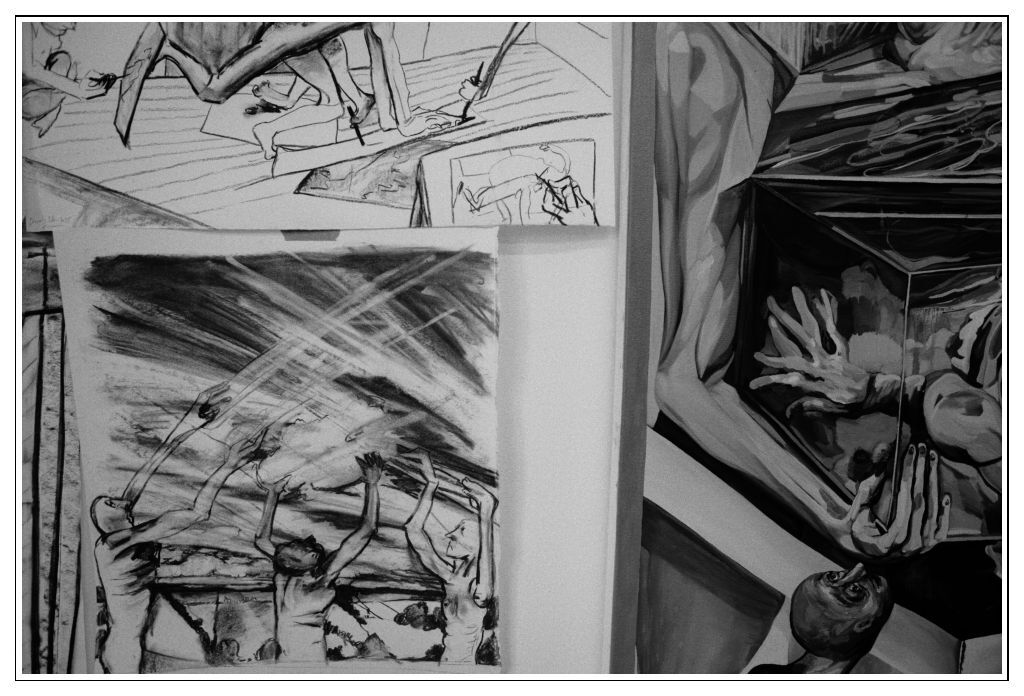
What I saw of Emma’s work before coming to her studio made me think of stained glass windows. Line jumping and running through the format as a guide, as a divider, as a denominator for fields of colour. Why is there a line; and is there ever an outline, in life, or are we imposing it between two neighbouring areas of colour? And it wasn’t just the line in Emma’s paintings that felt similar to the stained glass; it was also the colours that were so bright and clear and saturated; akin to the way a translucent wash painted on a pane of glass is illuminated; from behind; from within.
As soon as we start talking, we encounter a fascinating topic; first of many; a rabbit hole that seems to get more and more fascinating as we journey through it. But at its end we don’t reach a definite conclusion; or discover the raison d’être - other than how it connects to everything else; something else, equally fascinating and equally true; connected to the previous idea through some universal back-door. None of the leads are pathways to truth as an absolute statement; conclusion; but each multi-layered interest is a way of describing a facet of the essence of what is true, what is alive, in the moment.
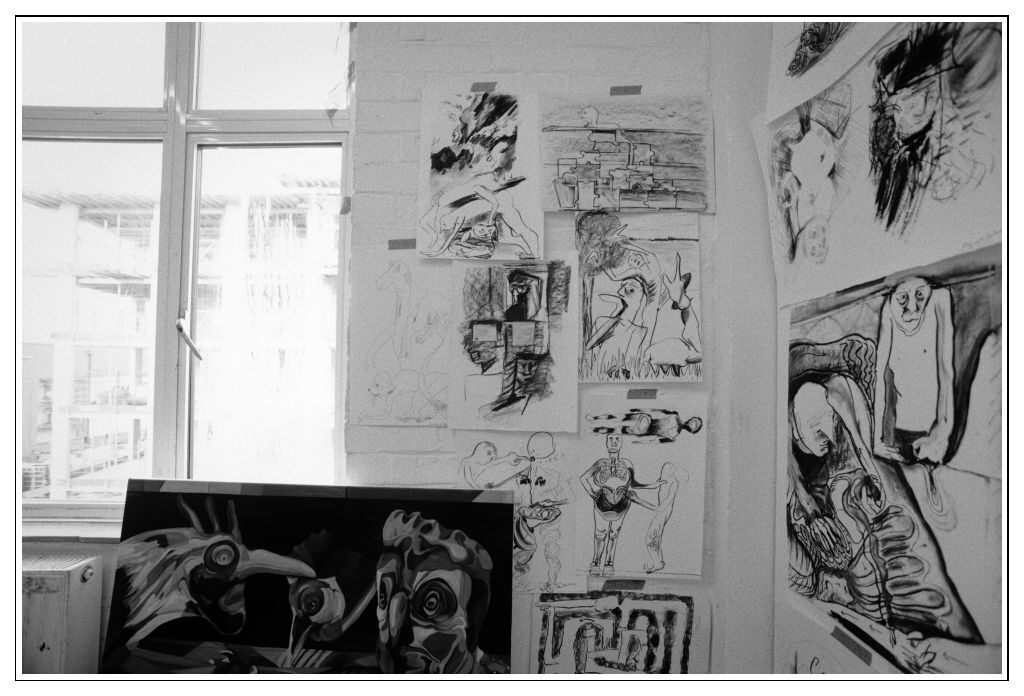
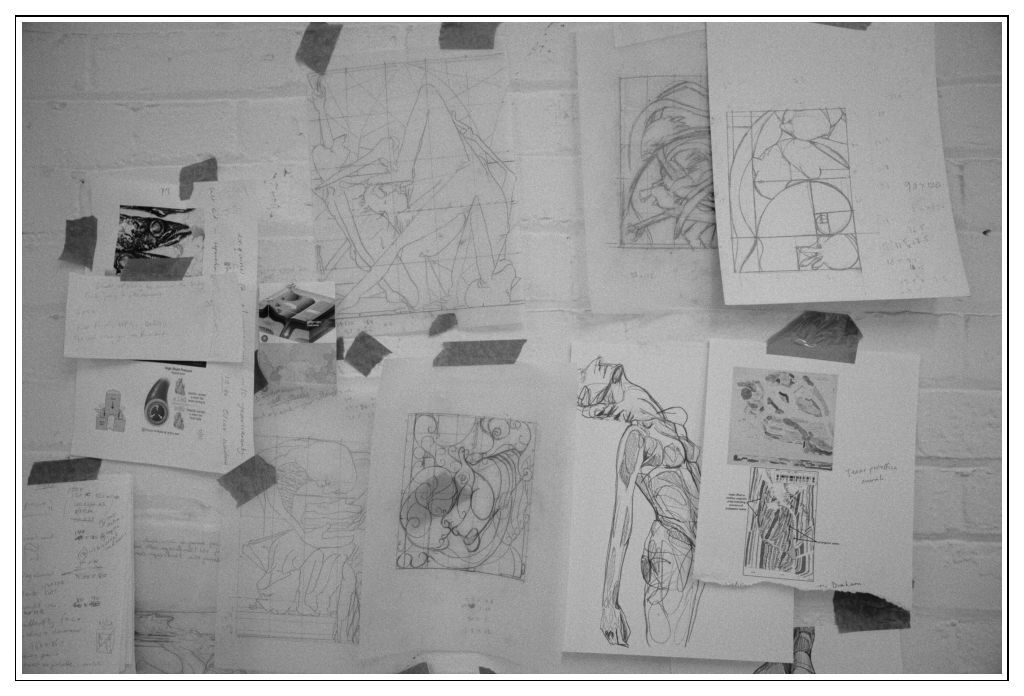
The wall on our left and the corner on the other side of the room were both covered by tacked A3 sheets of charcoal drawings on white paper. There were many of them; and Emma took out and went through another stack, the drawings jumping between one style to another from sheet to sheet. Connecting element; the charcoal line; like a run of a hare through a field; quick, impatient; although speedier than the lack of patience; driven by a much deeper impulse. It could be striving to capture a thought, an idea before it morphs into another; or as it morphs into another; and in so doing capturing it as efficiently as possible. Some of the drawings remind me of Honoré Daumier; other ones of quick court-room sketches. Only the courtroom seemed to be set in a dream world; a cross between an apocalyptic comic strip and an inner vision of what the most important three things to remember last week were. Low meets high only to fall through a wormhole of time and space and flip its importance yet again.
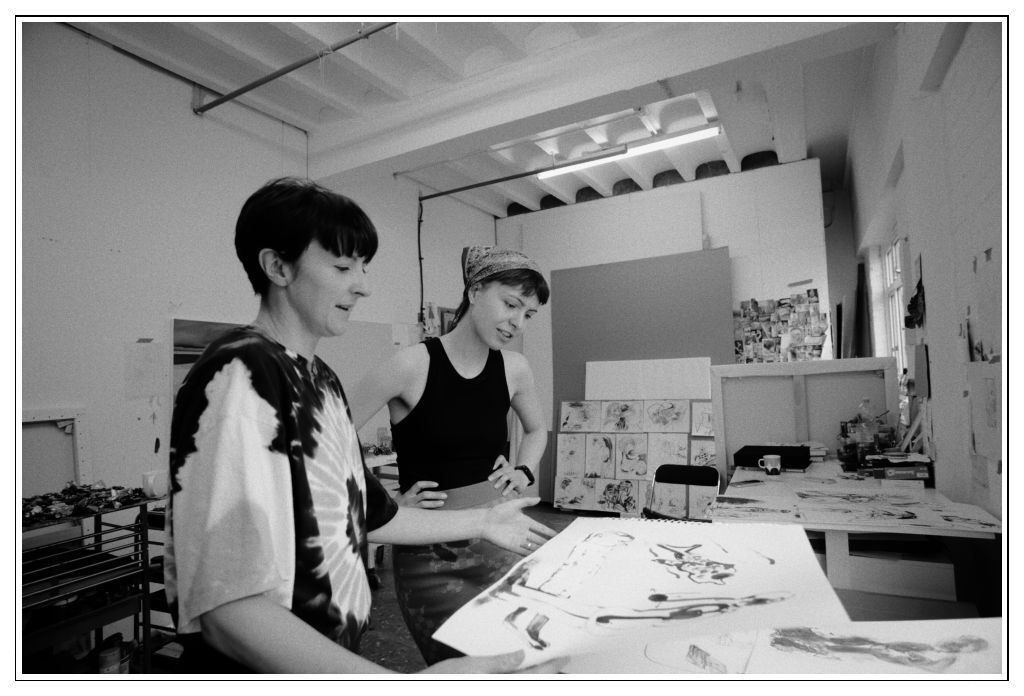
The line; the subject too; jumps and disjoints only to connect again at the other side. The topic; the plethora of visual language; all connected by the ease with which the line seems to have been drawn across the white abyss of the page. Figures extrapolated into geometrical shapes; tension not confined to be a mere a state of an inner world; but a transforming power to change matter and subjugate the entire scene.
The white is a space to imagine; to fill in the gaps; for the eye and the mind to rest and bring forth; to activate our own inner imagination; asking us to co-create the vision; the journey of thought that is suggested, that is outlined, by the artist.
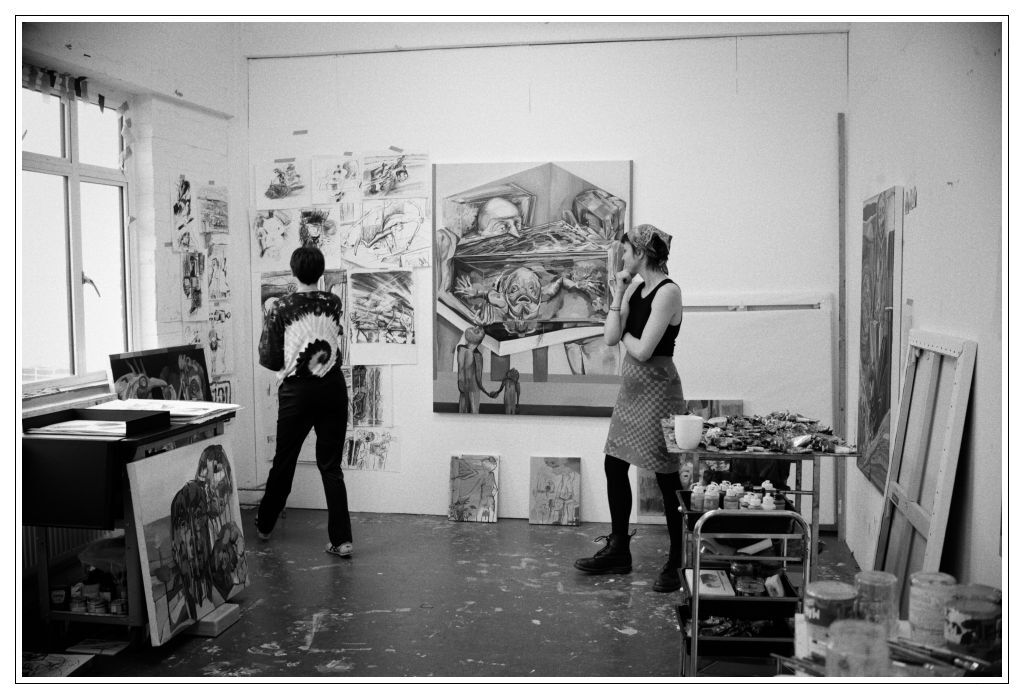
Landscapes; animals; people; endless variations; compositions that seem almost haphazard; but then when we follow the line they draw us in and closer, revealing details and relationships as we go along with them. The narrative unfolds and starts with the first recognisable thing; a foot, that leads our eyes to the next; up until that moment abstract shape; and only once we reach the foot’s big toe the seemingly abstract scribble reveals itself to be a face of a man in profile; and his sharp pointed nose poking the foot. Ouch, or why and then the head lifts; the heavier lines pulling us up and behind a foreign torso; lines and arrows indicate exchange; of air; of information. It is all connected; a chaotic, brimming, macabre one-liner; an outline of a foot on a straight line, arrows pointing downwards; to the word pressure.
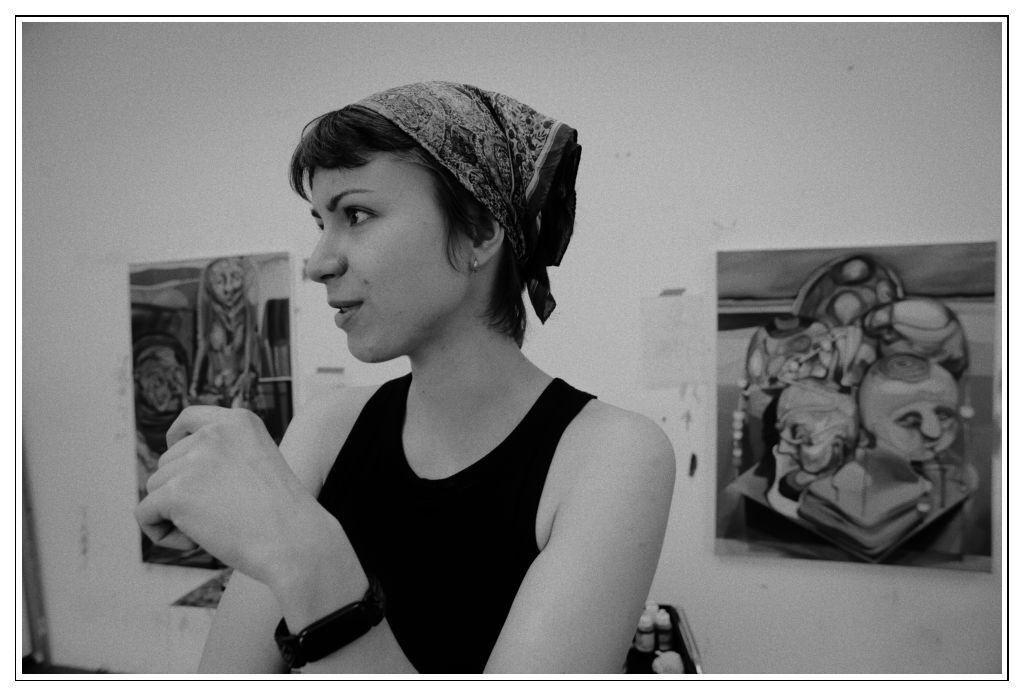
We talked about what it’s like to become a mother; as an artist.
“Initially, having another body, another subject was exciting, another thing to study. I haven’t drawn him directly very much even though I would like to - it is sort of overwhelming, how perfect he is and the practical challenges of it. I found myself rather than drawing him, drawing the way we connected - the curve of his mouth to my breast, the way his head fit into my arm, the scale of things. I made drawings about breast-feeding, looking at anatomy diagrams of how that changed the body to function, drawings about organs moving, the hole left in the belly after giving birth, the lonely feeling when the private thing contained and inside becomes a writhing demanding thing outside. Now age 3 we draw together; and he engages with my work and often asks me; what are you drawing? I showed him my drawing of our cat once and he said, but it doesn’t look like a cat.. he demanded me to explain to him what I am looking at, what I find interesting and why; I was drawing the way the cat lifts the leg, drawing as a way to understand..”
To understand; initially from an external, academic point of view, but that might be just one of the methodologies Emma uses that constitutes her research; but primarily the driving force is her drive which comes from an intensely subjective place; let me take this apart so I can understand it. What we are left with; or what we are given is a simulacrum of reality from Emma’s unique perspective. Unique and fascinating; and true to some kind of truth within; albeit subjective to Emma. And yet the point she arrives at is transferrable; understandable, the way her drawing unfolds is very similar to the way the experience of a thinking/being process is; a sensation; a clearly defined thought; a merging of; coalescence of ideas; and it all exists within the frame of our mind; within the frame of the paper, too.
“In a way, the more you [make], the more you realise that what you are doing that’s personal has a universality. So, it is relevant, it is not that you are saying that my experience is important or my view has to be understood. I think it’s realising, as a human, that if can get closer, to be true to what your understanding is, or to be true to what your curiosity is, or confusion, or contemplation. And to honour that, then I suppose there is an element of trust there that some part of that, will be felt by other people, will be universal.”
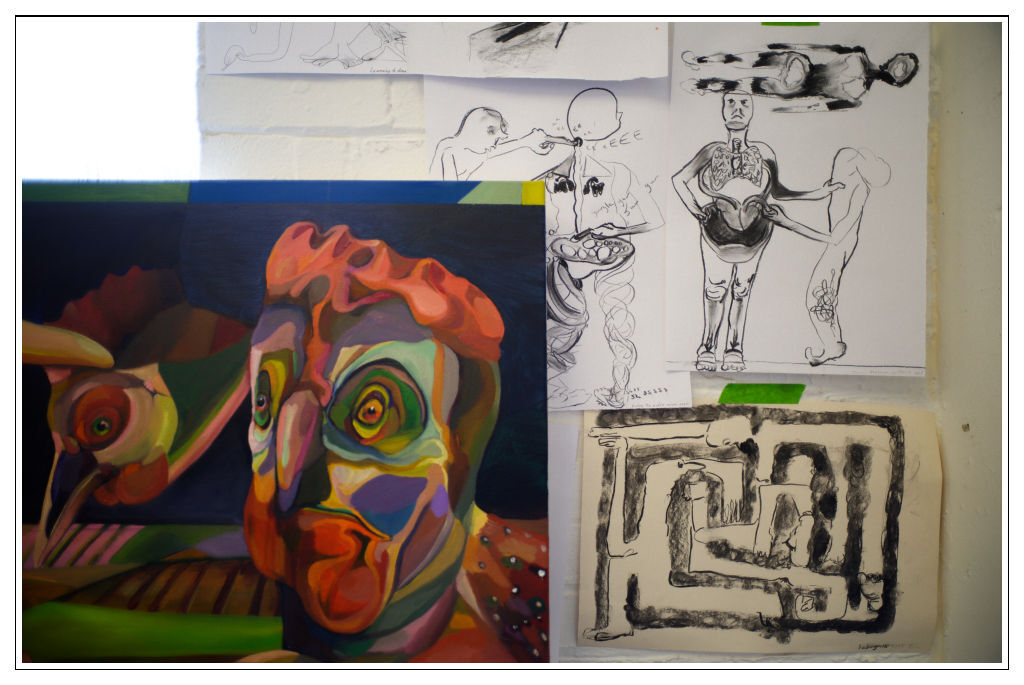
The intensity of the idea is compressed into the space of the painting; exploding in colour, into the geometrical undercurrents that make the figures twist and turn; not to make us emphasise with their discomfort per se; but to allow for the transitory sensation that sits physically in the painting; allow us to experience it as an in-between state. The colours sit at the edges of their scale; the turquoise green couldn’t be any truer to that particular shade; couldn’t be any brighter or denser; more it. And the same is true to all the other colours in the painting; oscillating at that precise frequency of their purity; exuberant. There is no colour serving as grey; a resting place. What would the job of the grey be anyway, why have an empty place for our eyes to rest and cleanse our palate, in a painting whose job it is to make us feel and re-imagine the fullness of human experience? There is no need to cleanse our palate from one to the next if they are all correct and exactly as they need to be; and the chromatic sensation feeds one into the other; there is enough white on the wall around.
Details that are anatomically correct; felt and absorbed; to make us believe and understand this is an arm; this is a crook in someone’s elbow and yet as the limb seduces our stare we realise it is elongated and morphs into some other-ness; to a representation of a sensation, to an object-like state.
The playful colour palette keeps it light; in the emotional sense. We might be pressed for space; our boundaries tested and squeezed through the constraints and demands of the present moment, and yet the only focus is to get through this very moment; without resistance; simply seeing it through. ‘This’ might be all just a part of the process; with all the forms and shapes that are perhaps new; but like a baby that needs to be born; we too are asked to shift our bones slightly for a moment, to jump through the eye of the needle, while countless angels dance on its tip.
Part of our conversation circles back to the influence of motherhood on Emma’s practice; and on keeping a balance; or rather, if there ever is such a thing as balance, other than an ideal to strive for?
“Creatively a child brings bliss windows at an extreme and the ranges of speed and a mundanity that I hadn’t experienced. But in order to reach this kind of joy (and to find ways to explore it in the creative process), the epiphany, the windows of cosmic awareness, something has to give. Sometimes that [feels like] being stretched in the other direction. I suppose it’s like being an accordion, at moments, as a parent, you are at the edges of your limits where it’s like right at the edge of its plausible notes, then you have to move in the opposite direction, melt in, or crumple.. that’s where it’s like, I’m at this place of like maximum effort.. and then there’s no choice but to compress.. this is excruciating, extraordinary and sometimes very frustrating.
Nothing is static, one week you feel like you’ve got it, they are sleeping and the next week they are going through a leap, or they have a stomach bug, or you’ve forgotten their rain coat or they decided they didn’t want to eat broccoli anymore.. And then they discover the word ‘actually’ and use it well and build a boa constrictor independently out of loo rolls and make you a drawing of a cloud full of fat rain and call you ‘gorgeous bum’ as a nickname and it’s bliss again. It is just very constant. ”
But maybe sometimes and for some of us, too much is exactly the right amount. Sometimes there is no stillness until there is just the right number of plates spinning; sometimes chaos is where we can find peace; fulfilment and fun and joy too. In a world where we all strive for some form of enlightened wholesomeness it is a gift to be reminded that forms don’t have to be beautiful and balanced to be true and alive and touch parts within our psyche that perhaps don’t have names in our language; states in between that we can recognise and emphasise with; recognise and understand perhaps a bit better after seeing and experiencing Emma’s paintings and drawings.
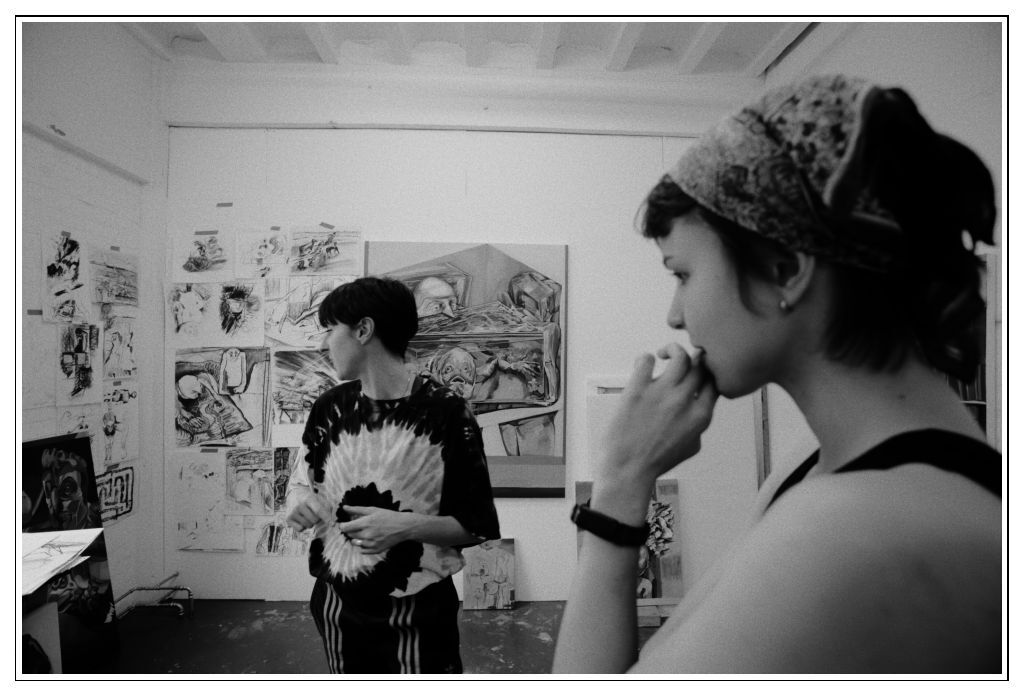
The saturated colours without rest are not uncomfortable. They are not aggressive; they do not assault our senses; they are heightened, yes, but as if asking us to remember what colour looks like; what it feels like; what colour is for. The many little fields are smooth; painterly; and yet there is something extremely raw to the whole thing; exposing. But perhaps the worlds that those painted windows are exposing are simply our inner states; places and moods between thought and feeling; one’s commonplace language falls short for. Half-formed ideas morphing; associations materialised like the flight of a bee seconds before awakening; only for the twenty-first century.
We come back to this idea a few times; and from different angles; having a system in demand; having enough stimuli to keep things alive and interesting. In the moment; in movement; exciting; and yet not overwhelm our capacity. Weather systems somehow seem like a good metaphor; in their vastness, complexity; local nature and relatedness but also a sense of chance and randomness; minor details unpredictably affecting the whole.
“Like how much complexity and context and detail do I need to include to make it make sense; and where is the line, when ‘it’, a painting, becomes overwhelmed and its structure collapses? And is that point a breakthrough or a break down?”
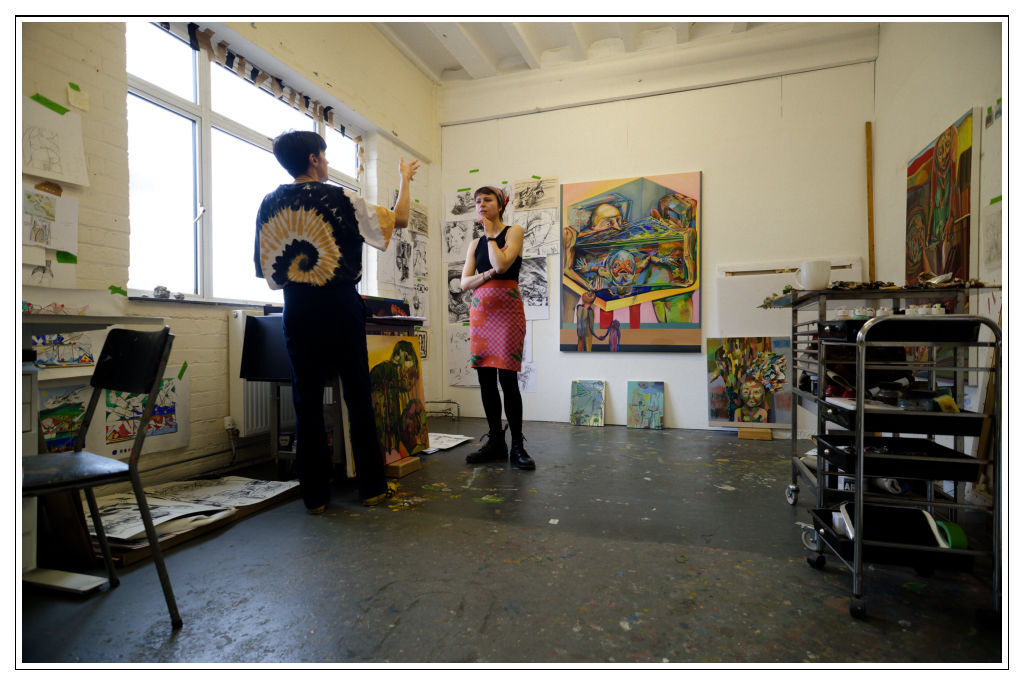
Re-listening to our telephone conversation, there is a portion of it intercepted by Emma’s cough; a chronic cough which is linked to her asthma. I am struck by how the incessant cough takes no focus off our topic; quite the opposite, for a few moments it feels as if there are two Emma’s, one with a cough in the background and one with a completely professional voice continuing our conversation. It didn’t seem to me to be humanly possible to switch so quickly from one another.
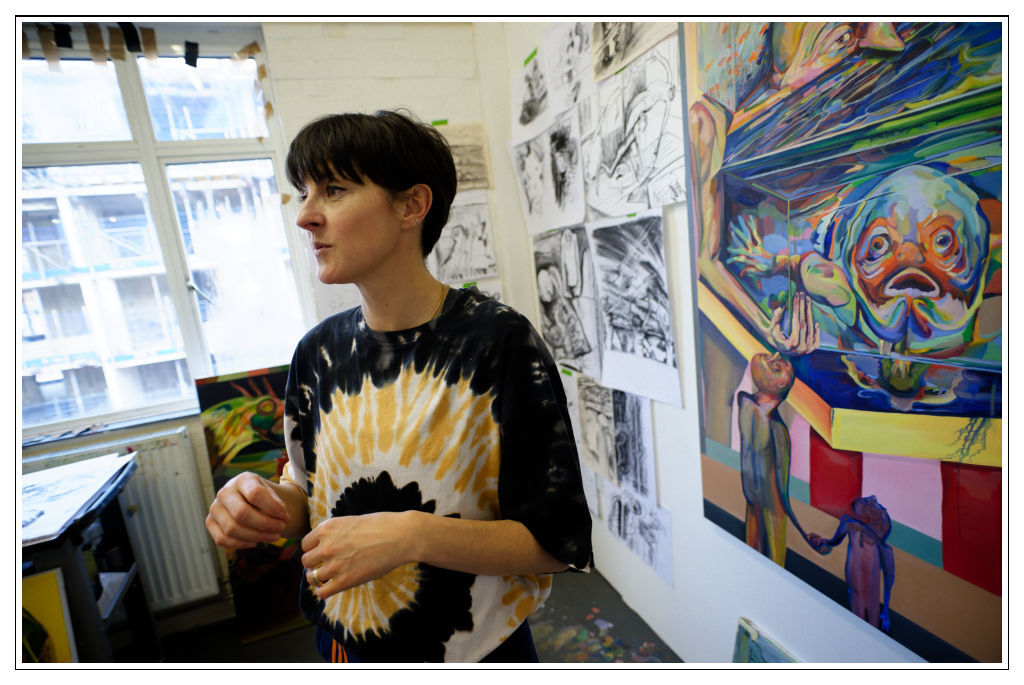
One of the paintings that were in the studio when we met was a painting with a fish in a cube-like structure; with a water reflection underneath it. The reflection was painted fluidly; with that kind of brush-work ease and bravado one would associate with Sargent or Hals; and yet it was such a detail in the whole it might be overlooked. Emma mentioned fish for their interesting breathing apparatus and their pressurised living zones; and that link made me wonder how much of that almost tactile physicality so present in her work is not an attempt to find a translation to her experience; to unlock certain doors of sensation and feelings that words can allude to; yet cannot capture them fully.
“I guess that’s part of it, how to hold this together, will this add up? Is what I am excited about translatable, and maybe it’s not. And sometimes I wonder if my paintings go too far, and I guess that’s to do with personal tolerance and understanding. And the chaos of divergent brains and life/social experiences. That kind of metaphorical lean. I keep going back to poetry too - in the way it seems to logically bring words together whilst breaking them; reconstructing and reordering them. ... [To] show something that we understand already. But [also that] we don’t really understand at all, I suppose, that’s the irony.”
XX
Emma mentions using various techniques to get to those places; be it following your memories and writing them all down in an attempt to unlock some door to parts of us that were dormant, forgotten. Autogenic exercises and dance and movement methods or using Kristin Linklater’s technique that turns to sounds and images to release the inner voice. An example Emma gives is the ‘discovering our/the actor’s inner king’; not as a way to represent what we think a king or a queen should look, talk and behave like; but the real place within us where our own version of that archetype lives. All of these seem to be gateways to accessing something deeper within; a place that in our daily life sits just outside the necessary conscious realm, yet where our memories and inner images, personal mythologies thrive; where our imagination resides.
“It’s exciting to me because, looking for some source material or a reference, collecting these different things from diverse domains, is about connection.. across time too, past, present, future. You’ve got different realms, hierarchies, knowledge, and then your own experience. [So] you have this other thing which is like a depth of all that within yourself."
As artists; as human beings, isn’t this - to an extent - what we all strive for - to uncover the archetypal, universal truth within us, through being as close to our own inner truth and seeing of things? To the experience of it; as closely and as honestly as it is possible; even if it means imbuing our canvases with all manners of things and colours; even if it means allowing the colours to explode from within; even if it means dancing a dance where one step further the structure collapses from overwhelm; but half a step back it implodes from not being saturated enough. Our jobs as artists is not to conform but to create that kind of universe that feeds our inner worlds; that represents them and takes the viewer on kind of a journey they wouldn't have been able to otherwise. To journey through; embrace, dance with and connect all this so that we might find new possibilities, new perspectives, discover options that may have remained hidden up until now.
Text © Martina Šišková
Photographs © Jon C Archdeacon
What I saw of Emma’s work before coming to her studio made me think of stained glass windows. Line jumping and running through the format as a guide, as a divider, as a denominator for fields of colour. Why is there a line; and is there ever an outline, in life, or are we imposing it between two neighbouring areas of colour? And it wasn’t just the line in Emma’s paintings that felt similar to the stained glass; it was also the colours that were so bright and clear and saturated; akin to the way a translucent wash painted on a pane of glass is illuminated; from behind; from within.
As soon as we start talking, we encounter a fascinating topic; first of many; a rabbit hole that seems to get more and more fascinating as we journey through it. But at its end we don’t reach a definite conclusion; or discover the raison d’être - other than how it connects to everything else; something else, equally fascinating and equally true; connected to the previous idea through some universal back-door. None of the leads are pathways to truth as an absolute statement; conclusion; but each multi-layered interest is a way of describing a facet of the essence of what is true, what is alive, in the moment.
The wall on our left and the corner on the other side of the room were both covered by tacked A3 sheets of charcoal drawings on white paper. There were many of them; and Emma took out and went through another stack, the drawings jumping between one style to another from sheet to sheet. Connecting element; the charcoal line; like a run of a hare through a field; quick, impatient; although speedier than the lack of patience; driven by a much deeper impulse. It could be striving to capture a thought, an idea before it morphs into another; or as it morphs into another; and in so doing capturing it as efficiently as possible. Some of the drawings remind me of Honoré Daumier; other ones of quick court-room sketches. Only the courtroom seemed to be set in a dream world; a cross between an apocalyptic comic strip and an inner vision of what the most important three things to remember last week were. Low meets high only to fall through a wormhole of time and space and flip its importance yet again.
The line; the subject too; jumps and disjoints only to connect again at the other side. The topic; the plethora of visual language; all connected by the ease with which the line seems to have been drawn across the white abyss of the page. Figures extrapolated into geometrical shapes; tension not confined to be a mere a state of an inner world; but a transforming power to change matter and subjugate the entire scene.
The white is a space to imagine; to fill in the gaps; for the eye and the mind to rest and bring forth; to activate our own inner imagination; asking us to co-create the vision; the journey of thought that is suggested, that is outlined, by the artist.
Landscapes; animals; people; endless variations; compositions that seem almost haphazard; but then when we follow the line they draw us in and closer, revealing details and relationships as we go along with them. The narrative unfolds and starts with the first recognisable thing; a foot, that leads our eyes to the next; up until that moment abstract shape; and only once we reach the foot’s big toe the seemingly abstract scribble reveals itself to be a face of a man in profile; and his sharp pointed nose poking the foot. Ouch, or why and then the head lifts; the heavier lines pulling us up and behind a foreign torso; lines and arrows indicate exchange; of air; of information. It is all connected; a chaotic, brimming, macabre one-liner; an outline of a foot on a straight line, arrows pointing downwards; to the word pressure.
We talked about what it’s like to become a mother; as an artist.
“Initially, having another body, another subject was exciting, another thing to study. I haven’t drawn him directly very much even though I would like to - it is sort of overwhelming, how perfect he is and the practical challenges of it. I found myself rather than drawing him, drawing the way we connected - the curve of his mouth to my breast, the way his head fit into my arm, the scale of things. I made drawings about breast-feeding, looking at anatomy diagrams of how that changed the body to function, drawings about organs moving, the hole left in the belly after giving birth, the lonely feeling when the private thing contained and inside becomes a writhing demanding thing outside. Now age 3 we draw together; and he engages with my work and often asks me; what are you drawing? I showed him my drawing of our cat once and he said, but it doesn’t look like a cat.. he demanded me to explain to him what I am looking at, what I find interesting and why; I was drawing the way the cat lifts the leg, drawing as a way to understand..”
To understand; initially from an external, academic point of view, but that might be just one of the methodologies Emma uses that constitutes her research; but primarily the driving force is her drive which comes from an intensely subjective place; let me take this apart so I can understand it. What we are left with; or what we are given is a simulacrum of reality from Emma’s unique perspective. Unique and fascinating; and true to some kind of truth within; albeit subjective to Emma. And yet the point she arrives at is transferrable; understandable, the way her drawing unfolds is very similar to the way the experience of a thinking/being process is; a sensation; a clearly defined thought; a merging of; coalescence of ideas; and it all exists within the frame of our mind; within the frame of the paper, too.
“In a way, the more you [make], the more you realise that what you are doing that’s personal has a universality. So, it is relevant, it is not that you are saying that my experience is important or my view has to be understood. I think it’s realising, as a human, that if can get closer, to be true to what your understanding is, or to be true to what your curiosity is, or confusion, or contemplation. And to honour that, then I suppose there is an element of trust there that some part of that, will be felt by other people, will be universal.”
The intensity of the idea is compressed into the space of the painting; exploding in colour, into the geometrical undercurrents that make the figures twist and turn; not to make us emphasise with their discomfort per se; but to allow for the transitory sensation that sits physically in the painting; allow us to experience it as an in-between state. The colours sit at the edges of their scale; the turquoise green couldn’t be any truer to that particular shade; couldn’t be any brighter or denser; more it. And the same is true to all the other colours in the painting; oscillating at that precise frequency of their purity; exuberant. There is no colour serving as grey; a resting place. What would the job of the grey be anyway, why have an empty place for our eyes to rest and cleanse our palate, in a painting whose job it is to make us feel and re-imagine the fullness of human experience? There is no need to cleanse our palate from one to the next if they are all correct and exactly as they need to be; and the chromatic sensation feeds one into the other; there is enough white on the wall around.
Details that are anatomically correct; felt and absorbed; to make us believe and understand this is an arm; this is a crook in someone’s elbow and yet as the limb seduces our stare we realise it is elongated and morphs into some other-ness; to a representation of a sensation, to an object-like state.
The playful colour palette keeps it light; in the emotional sense. We might be pressed for space; our boundaries tested and squeezed through the constraints and demands of the present moment, and yet the only focus is to get through this very moment; without resistance; simply seeing it through. ‘This’ might be all just a part of the process; with all the forms and shapes that are perhaps new; but like a baby that needs to be born; we too are asked to shift our bones slightly for a moment, to jump through the eye of the needle, while countless angels dance on its tip.
Part of our conversation circles back to the influence of motherhood on Emma’s practice; and on keeping a balance; or rather, if there ever is such a thing as balance, other than an ideal to strive for?
“Creatively a child brings bliss windows at an extreme and the ranges of speed and a mundanity that I hadn’t experienced. But in order to reach this kind of joy (and to find ways to explore it in the creative process), the epiphany, the windows of cosmic awareness, something has to give. Sometimes that [feels like] being stretched in the other direction. I suppose it’s like being an accordion, at moments, as a parent, you are at the edges of your limits where it’s like right at the edge of its plausible notes, then you have to move in the opposite direction, melt in, or crumple.. that’s where it’s like, I’m at this place of like maximum effort.. and then there’s no choice but to compress.. this is excruciating, extraordinary and sometimes very frustrating.
Nothing is static, one week you feel like you’ve got it, they are sleeping and the next week they are going through a leap, or they have a stomach bug, or you’ve forgotten their rain coat or they decided they didn’t want to eat broccoli anymore.. And then they discover the word ‘actually’ and use it well and build a boa constrictor independently out of loo rolls and make you a drawing of a cloud full of fat rain and call you ‘gorgeous bum’ as a nickname and it’s bliss again. It is just very constant. ”
But maybe sometimes and for some of us, too much is exactly the right amount. Sometimes there is no stillness until there is just the right number of plates spinning; sometimes chaos is where we can find peace; fulfilment and fun and joy too. In a world where we all strive for some form of enlightened wholesomeness it is a gift to be reminded that forms don’t have to be beautiful and balanced to be true and alive and touch parts within our psyche that perhaps don’t have names in our language; states in between that we can recognise and emphasise with; recognise and understand perhaps a bit better after seeing and experiencing Emma’s paintings and drawings.
The saturated colours without rest are not uncomfortable. They are not aggressive; they do not assault our senses; they are heightened, yes, but as if asking us to remember what colour looks like; what it feels like; what colour is for. The many little fields are smooth; painterly; and yet there is something extremely raw to the whole thing; exposing. But perhaps the worlds that those painted windows are exposing are simply our inner states; places and moods between thought and feeling; one’s commonplace language falls short for. Half-formed ideas morphing; associations materialised like the flight of a bee seconds before awakening; only for the twenty-first century.
We come back to this idea a few times; and from different angles; having a system in demand; having enough stimuli to keep things alive and interesting. In the moment; in movement; exciting; and yet not overwhelm our capacity. Weather systems somehow seem like a good metaphor; in their vastness, complexity; local nature and relatedness but also a sense of chance and randomness; minor details unpredictably affecting the whole.
“Like how much complexity and context and detail do I need to include to make it make sense; and where is the line, when ‘it’, a painting, becomes overwhelmed and its structure collapses? And is that point a breakthrough or a break down?”
Re-listening to our telephone conversation, there is a portion of it intercepted by Emma’s cough; a chronic cough which is linked to her asthma. I am struck by how the incessant cough takes no focus off our topic; quite the opposite, for a few moments it feels as if there are two Emma’s, one with a cough in the background and one with a completely professional voice continuing our conversation. It didn’t seem to me to be humanly possible to switch so quickly from one another.
One of the paintings that were in the studio when we met was a painting with a fish in a cube-like structure; with a water reflection underneath it. The reflection was painted fluidly; with that kind of brush-work ease and bravado one would associate with Sargent or Hals; and yet it was such a detail in the whole it might be overlooked. Emma mentioned fish for their interesting breathing apparatus and their pressurised living zones; and that link made me wonder how much of that almost tactile physicality so present in her work is not an attempt to find a translation to her experience; to unlock certain doors of sensation and feelings that words can allude to; yet cannot capture them fully.
“I guess that’s part of it, how to hold this together, will this add up? Is what I am excited about translatable, and maybe it’s not. And sometimes I wonder if my paintings go too far, and I guess that’s to do with personal tolerance and understanding. And the chaos of divergent brains and life/social experiences. That kind of metaphorical lean. I keep going back to poetry too - in the way it seems to logically bring words together whilst breaking them; reconstructing and reordering them. ... [To] show something that we understand already. But [also that] we don’t really understand at all, I suppose, that’s the irony.”
XX
Emma mentions using various techniques to get to those places; be it following your memories and writing them all down in an attempt to unlock some door to parts of us that were dormant, forgotten. Autogenic exercises and dance and movement methods or using Kristin Linklater’s technique that turns to sounds and images to release the inner voice. An example Emma gives is the ‘discovering our/the actor’s inner king’; not as a way to represent what we think a king or a queen should look, talk and behave like; but the real place within us where our own version of that archetype lives. All of these seem to be gateways to accessing something deeper within; a place that in our daily life sits just outside the necessary conscious realm, yet where our memories and inner images, personal mythologies thrive; where our imagination resides.
“It’s exciting to me because, looking for some source material or a reference, collecting these different things from diverse domains, is about connection.. across time too, past, present, future. You’ve got different realms, hierarchies, knowledge, and then your own experience. [So] you have this other thing which is like a depth of all that within yourself."
As artists; as human beings, isn’t this - to an extent - what we all strive for - to uncover the archetypal, universal truth within us, through being as close to our own inner truth and seeing of things? To the experience of it; as closely and as honestly as it is possible; even if it means imbuing our canvases with all manners of things and colours; even if it means allowing the colours to explode from within; even if it means dancing a dance where one step further the structure collapses from overwhelm; but half a step back it implodes from not being saturated enough. Our jobs as artists is not to conform but to create that kind of universe that feeds our inner worlds; that represents them and takes the viewer on kind of a journey they wouldn't have been able to otherwise. To journey through; embrace, dance with and connect all this so that we might find new possibilities, new perspectives, discover options that may have remained hidden up until now.
Text © Martina Šišková
Photographs © Jon C Archdeacon